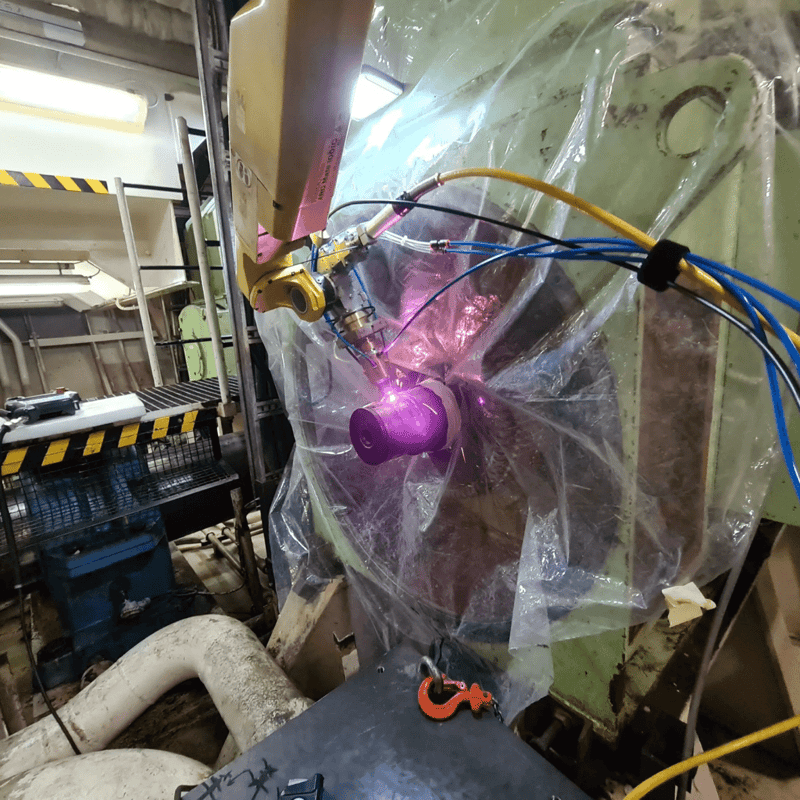
On-Site Laser Cladding
Repair on site. No dismantling, no transport.
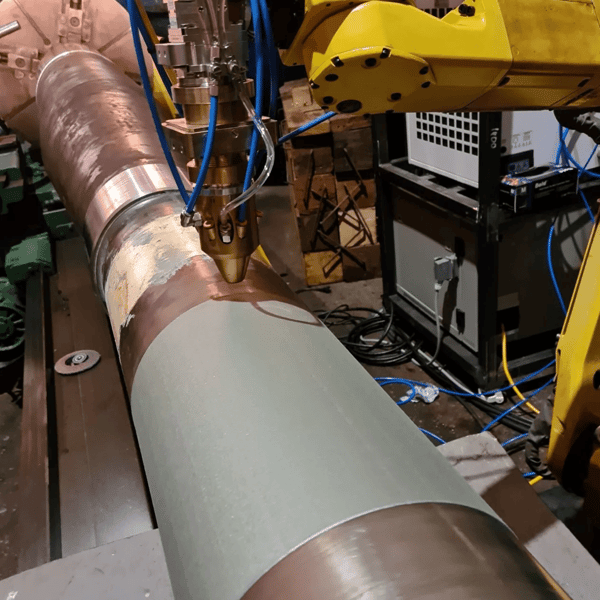
Large components often cannot be moved — or moving them costs more than the repair. We bring a robotic laser cladding cell to where the equipment stands and restore worn or damaged surfaces in place: engine blocks, bearing seats in large housings, sealing faces, flanges, bores, shafts and rotor journals. The damaged area is built up with a metallurgically bonded layer and machined back to original dimensions — no dismantling, no shipping, no waiting for OEM spares.
Get a Quote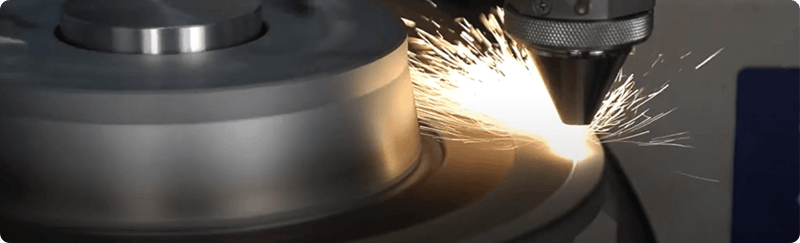
Proven on site
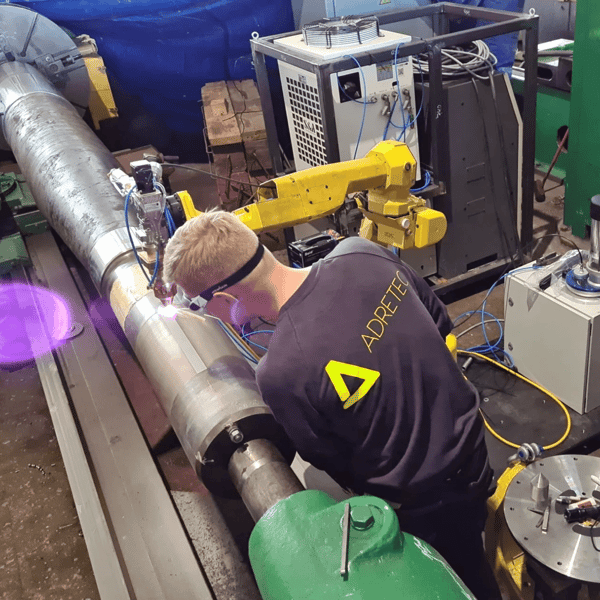
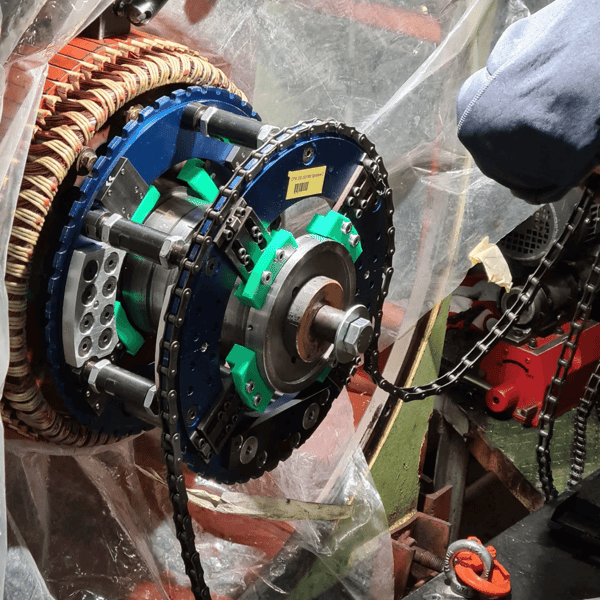
Recent on-site job: 11 MW electric motor rotor, Estonia.
Marine
Engine blocks, bearing housings, sealing faces, flanges and shafts restored on board or in dry dock — without lifting heavy components out of the vessel.
Power Generation
Generator and motor rotors, turbine casings, bearing seats and pump housings restored at the plant — like the 11 MW motor rotor we repaired on site in under 18 hours.
Pulp & Paper
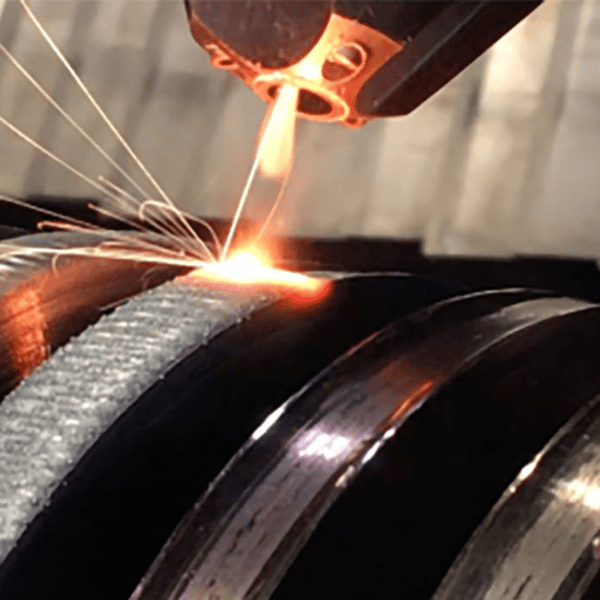
Roll journals, gearbox housings, bearing seats and drive shafts restored during planned shutdowns, without sending heavy parts to a workshop.
Mining & Heavy Industry
Crusher and mill housings, large bearing seats, shafts and conveyor components restored where they operate, cutting downtime and transport costs.
Why on-site laser cladding
What you gain compared with replacement or workshop repair:
No transport
Engine blocks, large housings, rotors and shafts stay in place — no crane, trucking or packaging costs and no risk of transport damage.
Any geometry
The robotic head reaches bores, bearing seats, sealing faces and flat surfaces, not only round shafts — with an even, reproducible layer and full metallurgical bonding.
Low heat input
Laser cladding puts far less heat into the part than conventional welding, minimising distortion and residual stress.
Better than original
Stainless and wear-resistant alloys such as 316L can make the repaired surface more resistant to corrosion than the original material.
Machined to size
After cladding, the surface is machined back to original dimensions and tolerances — ready for bearings, seals or mating parts.
How on-site cladding works
Send us photos of the worn part — we reply with a first assessment within 24 hours.
Send photos and dimensions
Photos of the damage, drawings or basic dimensions and the site location are enough for a first assessment.
Assessment and repair plan
We define the cladding material, layer thickness and machining approach; if needed we inspect or 3D-scan on site.
Mobilisation and cladding
Our team and robotic cladding cell arrive on site and build up the worn surface.
Machining and handover
The surface is machined to original dimensions, checked and handed back for assembly.
Damaged surface on a large component? Send us photos.
Send photos of the damaged area, the component type, its dimensions and where it is installed. We will tell you whether it can be restored on site, how long it will take and what it will cost — usually within 24 hours.